Guide
GST bill format for clothing shops
What should a GST bill of a clothing shop contain?
A GST tax invoice from a clothing shop must show the shop’s name, address and GSTIN, a unique invoice number and date, the customer’s name and GSTIN if they are registered, each item’s description, HSN code, quantity and taxable value, the GST rate and the CGST and SGST amounts (or IGST for inter-state sales), and the invoice total.
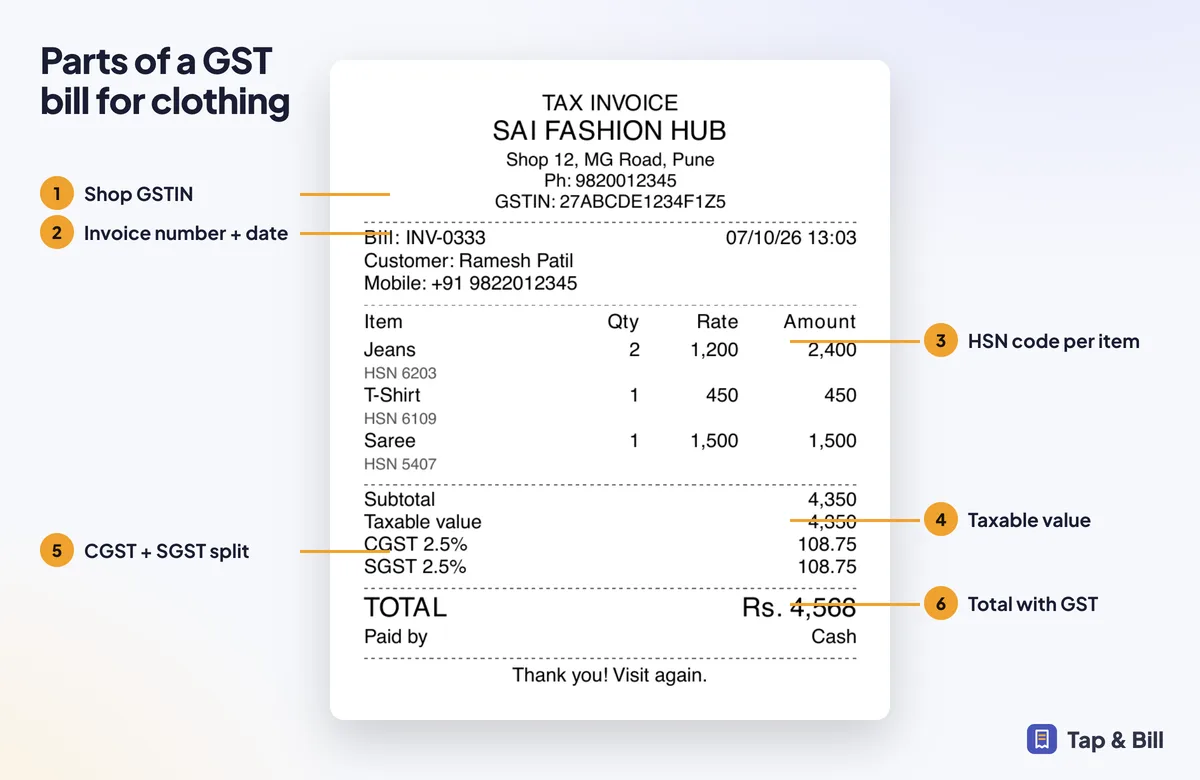
Mandatory fields on a GST tax invoice
Rule 46 of the CGST Rules, 2017 lists what a tax invoice must contain. For a retail clothing counter, the fields that matter are:
| Field | What to print |
|---|---|
| Supplier details | Shop name, address and 15-character GSTIN |
| Invoice number | Consecutive serial number, unique for the financial year, up to 16 characters (letters, digits, “-” and “/”) |
| Date | Date of issue |
| Customer | Name, address and GSTIN if the buyer is GST-registered (B2B). For unregistered buyers, name and address are needed only for bills of ₹50,000 or more |
| HSN code | HSN of each item: 4 digits if turnover is up to ₹5 crore (needed on B2B invoices), 6 digits above ₹5 crore |
| Item details | Description, quantity, unit, value and taxable value after discount |
| Tax | GST rate and amount, split into CGST + SGST for sales within the state, or IGST for inter-state sales |
| Place of supply | State name, for inter-state supplies |
| Signature | Signature or digital signature of the supplier (not needed on e-invoices) |
Composition dealers cannot charge GST on sales. They issue a bill of supply that says “composition taxable person, not eligible to collect tax on supplies”, not a tax invoice.
GST rates on clothes (from 22 September 2025)
After the GST Council’s 56th meeting, the rates on readymade garments and made-up textile articles were changed with effect from 22 September 2025:
| Sale value per piece | GST rate | Earlier rate |
|---|---|---|
| Up to ₹2,500 | 5% | 5% up to ₹1,000, 12% above |
| Above ₹2,500 | 18% | 12% |
Fabrics, including many sarees sold as fabric, have their own rates. Rates change from time to time; always confirm the rate for your products with your CA or the CBIC rate notifications.
Common HSN codes for clothing
| Item | HSN (4-digit) |
|---|---|
| T-shirts, vests (knitted) | 6109 |
| Men’s shirts (not knitted) | 6205 |
| Men’s trousers, jeans, shorts (not knitted) | 6203 |
| Women’s suits, dresses, skirts, trousers (not knitted) | 6204 |
| Women’s blouses and shirts (not knitted) | 6206 |
| Jackets and coats, men (not knitted) | 6201 |
| Babies’ garments (not knitted) | 6209 |
Chapter 61 covers knitted or crocheted garments and chapter 62 covers garments that are not knitted. Pick the code that matches the fabric and item, and check with your CA.
How Tap & Bill prints a GST bill
Turn on GST tax invoice
Enter your GSTIN and GST rate in Settings. The bill title changes to TAX INVOICE.
Add HSN per category
Each category (Shirt, Kurta…) gets its HSN code, printed on every item line.
Bill normally
The server works out taxable value after discount and splits GST into CGST and SGST.
B2B buyer?
Type the customer’s GSTIN. It is saved and filled in next time.
Note: Tap & Bill applies one GST rate per shop today. If you sell pieces both below and above ₹2,500, tell us: rates by price slab are on our roadmap.