Guide
GST on clothes: 5% or 18%? The ₹2,500 rule with bill examples
Is GST on clothes 5% or 18%?
Since 22 September 2025, readymade garments sold at ₹2,500 or less per piece carry 5% GST, and pieces sold above ₹2,500 carry 18%. The limit is checked on each piece, not on the whole bill, on the price after discount and without GST. So a tag that already includes GST stays at 5% up to ₹2,625, and a discount that brings a piece to ₹2,500 or less moves it from 18% to 5%.
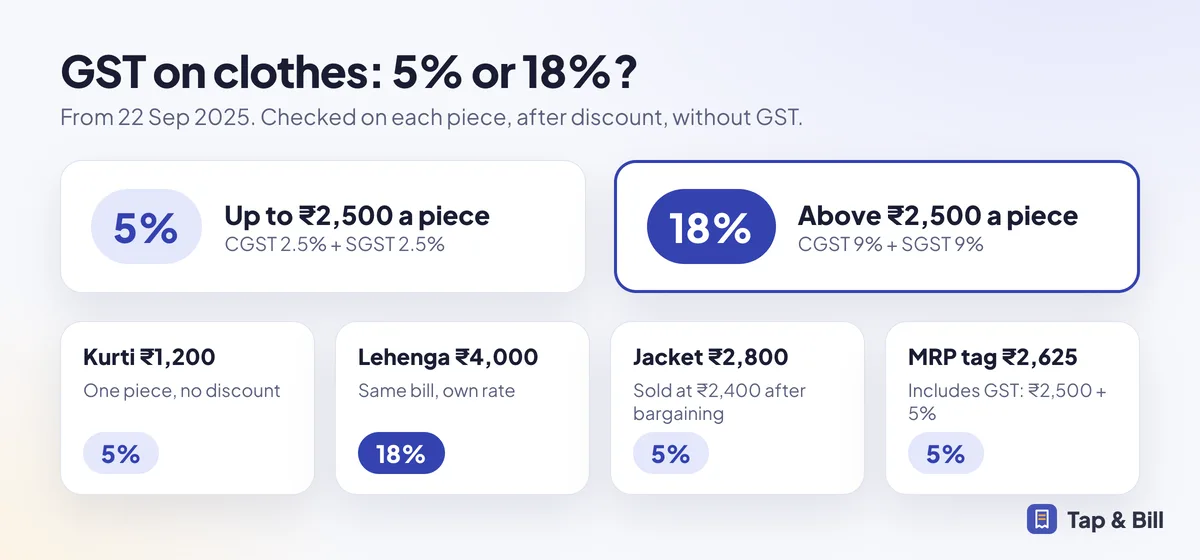
GST rates on clothes from 22 September 2025
| Sale value of one piece (after discount, without GST) | GST | CGST + SGST | Before 22 Sep 2025 |
|---|---|---|---|
| Up to ₹2,500 | 5% | 2.5% + 2.5% | 5% up to ₹1,000, 12% above |
| Above ₹2,500 | 18% | 9% + 9% | 12% |
The change came from the GST Council’s 56th meeting and applies to readymade garments and made-up textile articles. Footwear has the same ₹2,500 limit, per pair. Fabric, including most sarees sold as fabric, is not under this rule (see below).
The ₹2,500 rule in four points
- Per piece, not per bill. Ten ₹500 T-shirts on one bill are ₹5,000, but each piece is ₹500, so all ten are at 5%.
- After discount. GST is charged on what the customer actually pays. A ₹2,800 tag sold at ₹2,400 is a ₹2,400 piece.
- Without GST. The ₹2,500 is the value before GST. If your tag includes GST, take the GST out first.
- Exactly ₹2,500 is 5%. The higher rate starts above ₹2,500.
How to calculate GST on a piece of clothing
Take the price of one piece
The price the customer pays for one piece, after bargaining or its share of a bill discount.
Take out GST if the tag includes it
Divide by 1.05. If the result is ₹2,500 or less, the piece is at 5%.
Pick the rate
₹2,500 or less: 5%. Above ₹2,500: 18%.
Work out the GST
Value × rate, split half and half into CGST and SGST.
Example 1: one bill, two rates
GST added on top of the price. A kurti and a lehenga on the same bill:
| Item | Price | Rate | CGST | SGST | Total |
|---|---|---|---|---|---|
| Kurti | ₹1,200 | 5% | ₹30 | ₹30 | ₹1,260 |
| Lehenga | ₹4,000 | 18% | ₹360 | ₹360 | ₹4,720 |
| Bill | ₹5,200 | ₹390 | ₹390 | ₹5,980 |
One rate for the whole bill would be wrong either way: 5% on everything undercharges the lehenga by ₹520, and 18% on everything overcharges the kurti by ₹156.
Example 2: per piece, not per line
| Item | Line | One piece | Rate | GST | Total |
|---|---|---|---|---|---|
| Shirt × 2 at ₹1,400 | ₹2,800 | ₹1,400 | 5% | ₹140 | ₹2,940 |
| Blazer × 1 | ₹2,600 | ₹2,600 | 18% | ₹468 | ₹3,068 |
| Bill | ₹5,400 | ₹608 | ₹6,008 |
The shirt line is above ₹2,500, but each shirt is ₹1,400, so it stays at 5%. The blazer is one piece above ₹2,500, so it is 18%.
Example 3: a bill discount moves a piece from 18% to 5%
A sherwani at ₹2,700 and a kurta at ₹900. The customer asks for 10% off the bill (₹360). The discount is shared over the pieces by their price, so ₹270 comes off the sherwani and ₹90 off the kurta:
| Sherwani | Kurta | GST | Customer pays | |
|---|---|---|---|---|
| No discount | ₹2,700 at 18% (₹486) | ₹900 at 5% (₹45) | ₹531 | ₹4,131 |
| ₹360 bill discount | ₹2,430 at 5% (₹121.50) | ₹810 at 5% (₹40.50) | ₹162 | ₹3,402 |
After its share of the discount, the sherwani is ₹2,430, so it moves to 5%. The customer pays ₹729 less, but your sales without GST fall by only ₹360: the rest is GST you no longer charge. Bargaining works the same way: a ₹2,800 jacket sold at ₹2,400 is at 5%, ₹120 GST, ₹2,520 in total.
Example 4: tags that already include GST (MRP)
Most shops with printed MRP tags charge the tag price and show the GST inside it. The rate is decided on the value without GST:
| Item | Tag (GST included) | Without 5% | Rate | Taxable value | GST in the tag |
|---|---|---|---|---|---|
| Kurta set | ₹2,600 | ₹2,476.19 | 5% | ₹2,476.19 | ₹123.81 |
| Dress | ₹3,500 | ₹3,333.33 | 18% | ₹2,966.10 | ₹533.90 |
| Customer pays | ₹6,100 | ₹5,442.29 | ₹657.71 |
On the bill: 5% taxable ₹2,476.19 with CGST ₹61.91 + SGST ₹61.90, and 18% taxable ₹2,966.10 with CGST ₹266.95 + SGST ₹266.95. The customer pays exactly the tags.
MRP tags between ₹2,626 and ₹2,950: the grey zone
| Tag price (GST included) | Rate in the Tap & Bill app | You keep (without GST), example |
|---|---|---|
| Up to ₹2,625 | 5% (₹2,625 ÷ 1.05 = ₹2,500) | ₹2,625 tag: ₹2,500 |
| ₹2,626 to ₹2,950 | 18% (see below) | ₹2,700 tag: ₹2,288.14 |
| Above ₹2,950 | 18% (above ₹2,500 either way) | ₹3,500 tag: ₹2,966.10 |
For tags in the middle band, taking out 5% leaves more than ₹2,500 (so not 5%), but taking out 18% leaves less than ₹2,500. The Tap & Bill app tries 5% first and charges 18% when the value is above ₹2,500, so a ₹2,700 tag is at 18%. Some advisers read this band differently, so ask your CA. Note the cost: a ₹2,700 tag leaves you ₹211.86 less than a ₹2,625 tag. Many shops simply avoid tags in this band.
Calculator: GST on one line
Type the tag price of one piece, how many pieces and any discount on the line. The rate and GST follow the same rule the app uses.
Which items follow the ₹2,500 rule?
| Item | Rule | In Tap & Bill |
|---|---|---|
| Readymade garments (HSN chapters 61 and 62): shirts, jeans, kurtis, suits, kids wear, hosiery | 5% up to ₹2,500 a piece, 18% above | Clothes rule |
| Footwear (chapter 64) | 5% up to ₹2,500 a pair, 18% above | Clothes rule; see footwear shops |
| Sarees and fabric sold as fabric (chapters 50 to 55) | Treated as fabric, not garments; tax sites list sarees at 5% at any price | Give the Saree category a fixed 5% rate |
| Accessories such as belts, bags or perfume | Their own rate | Fixed rate per category, as your CA advises |
Rates here are a guide as of October 2026, not tax advice. Confirm the rate and HSN code of your products with your CA. HSN codes for common garments and what a tax invoice must show are in our GST bill format guide.
Doing it in Tap & Bill
Choose the clothes rule
Settings → GST → Clothes rule (5% up to ₹2,500 a piece, 18% above). Then choose “GST added on top” or “Price includes GST”.
Set fixed rates where needed
On Prices & categories, give sarees, belts or bags their own fixed rate. Everything else follows the clothes rule.
Bill as usual
The billing screen shows each item’s GST %. Change a rate or add a bill discount and the server works the rate out again for every piece.
Hand the report to your CA
The bill prints CGST + SGST for each rate, and the month’s GST report is split rate-wise (B2B and B2C) with an HSN summary and credit notes.
More on the invoice and the CA report: GST billing. Hindi: कपड़ों पर GST बिल कैसे बनाएं.