“Ek kilo Sona Masoori, aadha kilo moong”
Set loose rice and dal to Sold by: kg with the price per kg. Tap 1 kg or 500 g, type 2.5, or type “₹100” and the app works out the weight. Billing by the kg.
Wedding season 2026 · weddings from 21 Nov · fast bills in the rush, udhaar with limits · 14 days free, then the ₹0 Free plan or ₹199/month · Shop checklist · Free sale poster
For rice, grain and anaj shops
Which billing app works for a rice or grain shop?
One that bills loose rice and dal by the kg and full bags by the piece on the same bill, puts 0% GST on loose grain and 5% on labelled packs, and keeps hotel and mess accounts on udhaar. Tap & Bill does this on an Android phone or any computer: “₹100 ka chawal” works out the weight, walk-in bills take a UPI QR, and each udhaar customer can have a credit limit. It has no weighing-scale link, stock in kg, or aadhat / mandi fee entries. Free plan: 60 bills a month at ₹0; paid plans from ₹199 a month.
No card · no ads in the app · your bills, customers and udhaar stay yours: nothing is deleted if you stop paying
Set loose rice and dal to Sold by: kg with the price per kg. Tap 1 kg or 500 g, type 2.5, or type “₹100” and the app works out the weight. Billing by the kg.
A 26 kg bag is one item priced per bag, billed in pieces next to the loose lines. Bag weight goes in the item name.
Give each item its own rate: loose grain and bags over 25 kg at 0%, labelled packs up to 25 kg at 5%. See the GST table.
Each hotel, mess or smaller shop is a customer with an udhaar balance and an optional credit limit; “Remind all” sends each one a WhatsApp reminder from your phone.
Walk-in bills need no name or number; your UPI QR shows the exact amount on screen and on the receipt.
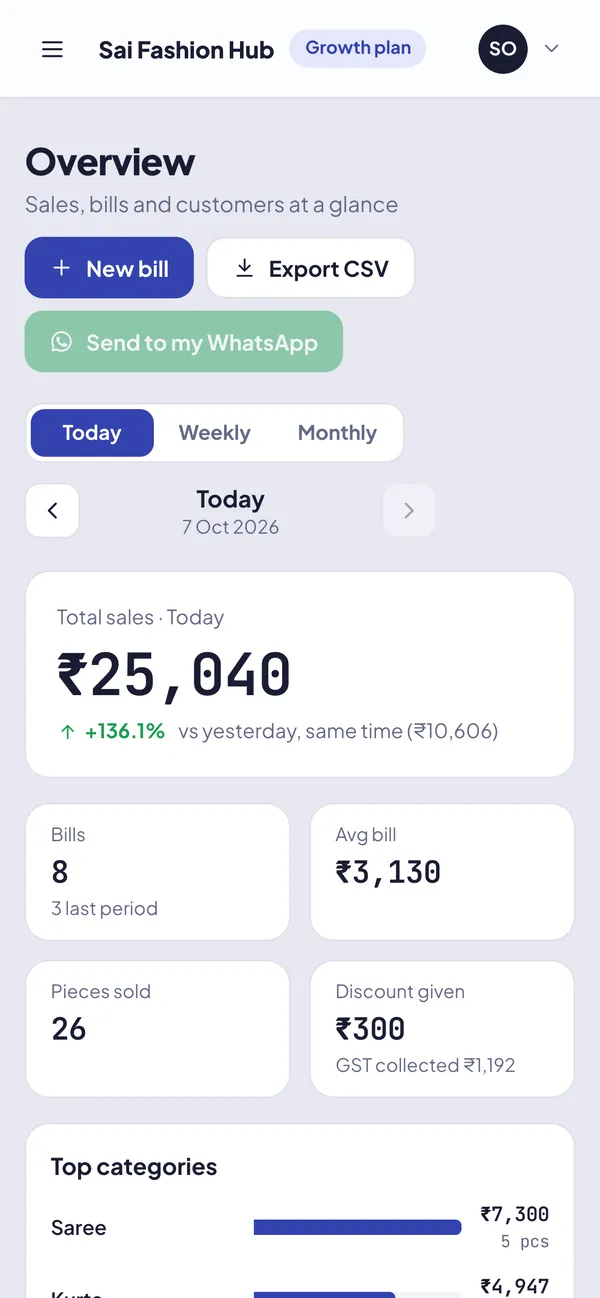
See today’s sales, cash vs UPI and udhaar on your phone, and count the drawer at night with galla day close.
Pick “Kirana / general store” at sign-up (it adds a few common items you can rename or delete), then paste your list once, one “name price” per line (“Kolam rice loose 48”), or import it from Excel on the computer. Set loose items to kg; keep bags and packs as pieces. A grain shop might start with:
A hotel orders four 26 kg bags of Sona Masoori, two 5 kg packs of basmati, loose toor dal, an atta pack and loose sugar from a GST-registered grain shop. Prices include GST where there is any; the shop’s GST is “same rate on everything”, 5%, and the exempt lines carry their own 0%. The prices are made up for the example:
| Item | Qty | Price | GST | Value without GST | GST inside |
|---|---|---|---|---|---|
| Sona Masoori rice 26 kg bag | 4 | ₹1,300 | 0% | ₹5,200 | ₹0.00 |
| Basmati rice 5 kg pack | 2 | ₹525 | 5% | ₹1,000 | ₹50.00 |
| Toor dal (loose) | 10 kg | ₹140/kg | 0% | ₹1,400 | ₹0.00 |
| Chakki atta 10 kg pack | 1 | ₹420 | 5% | ₹400 | ₹20.00 |
| Sugar (loose) | 5 kg | ₹44/kg | 5% | ₹209.52 | ₹10.48 |
| Hotel pays | ₹8,290 | ₹8,209.52 | ₹80.48 |
₹6,600 is at 0% (the 26 kg bags and the loose dal) and ₹1,609.52 is the value at 5% (CGST ₹40.24 + SGST ₹40.24); the tax invoice lists both rates and the HSN of each item. The hotel pays ₹5,000 by UPI and ₹3,290 goes on its account. It already owed ₹4,200, so its udhaar is now ₹7,490, inside the ₹15,000 limit you set for it. Had it crossed the limit, the app would ask you first, and a staff member would need your PIN.
| Line | How it was added | Amount |
|---|---|---|
| Kolam rice 2.083 kg × ₹48/kg | Customer asked for “₹100 ka”: typed 100 on “₹ amount” | ₹100 |
| Toor dal 1 kg × ₹150/kg | Tapped 1 kg | ₹150 |
| Moong dal 0.5 kg × ₹130/kg | Tapped 500 g | ₹65 |
| Wheat 10 kg × ₹32/kg | Typed 10 | ₹320 |
| Total | ₹635 |
     ANNAPURNA GRAIN STORE
      Gandhi Ganj, Raipur
--------------------------------
Bill: INV-1184    07/11/26 09:15
Cust: Walk-in
--------------------------------
Item          Qty  Rate   Amount
Kolam rice                   100
  2.083 kg x 48/kg
Toor dal                     150
  1 kg x 150/kg
Moong dal                     65
  0.5 kg x 130/kg
Wheat                        320
  10 kg x 32/kg
--------------------------------
Subtotal                     635
--------------------------------
TOTAL                     Rs 635
Paid by                     Cash
--------------------------------
FSSAI Reg. No. 2xxxxxxxxxxxxx“₹100 ka chawal” at ₹48 a kg is 2.083 kg; the line stays ₹100. A grain shop that is not GST-registered picks No GST and every bill prints like this, without tax lines.
Grain is either 0% or 5%, and what decides it is the packing, not the brand. Loose grain weighed in front of the customer is exempt; a labelled retail pack of up to 25 kg is 5%. A single bag of more than 25 kg is not a “pre-packaged and labelled” retail pack, so it is exempt too.
| What you sell | HSN heading | GST |
|---|---|---|
| Rice, wheat, jowar, bajra, ragi, maize, sold loose (weighed in front of the customer) | 1006, 1001, 1008, 1005 | 0% |
| Atta and other flours, pulses (dal), sold loose | 1101, 1102, 0713 | 0% |
| A single bag of more than 25 kg (26 kg, 30 kg, 50 kg bags) | 1006, 1001, 0713 | 0% |
| Rice, atta, dal in a labelled retail pack up to 25 kg (1 kg, 5 kg, 10 kg, 25 kg) | 1006, 1101, 0713 | 5% |
| Several retail packs sold together in one big bag (10 packs of 5 kg) | same as above | 5% |
| Loose sale from a 25 kg pack the shop opened | same as above | 0% |
Watch out: a rice miller’s 20 kg bag is still taxed even if the miller left the label off (the FAQ says it must carry the declarations, so it counts as pre-packaged). Poha, murmura and other processed grain have their own entries; check them with your CA. Do you need a GST number at all? A shop that sells only exempt goods (loose grain) does not have to register (CGST Act s.23(1)(a)); one that also sells packed 5% goods counts all its sales, exempt ones too, towards the ₹40 lakh limit (lower in some north-eastern and hill states). A composition grain dealer gives a bill of supply and pays 1% on taxable sales only, leaving out exempt loose grain.
In Tap & Bill: Settings → GST → “Same rate on everything”, 5%; give loose items and big bags their own 0% on the item, with HSN 1006 (rice), 1001 (wheat), 0713 (dal) or 1101 (atta). The rate and HSN print on every tax invoice. Mandi fee, market cess and APMC charges are state levies, not GST: the app has no field for them. More: GST billing.
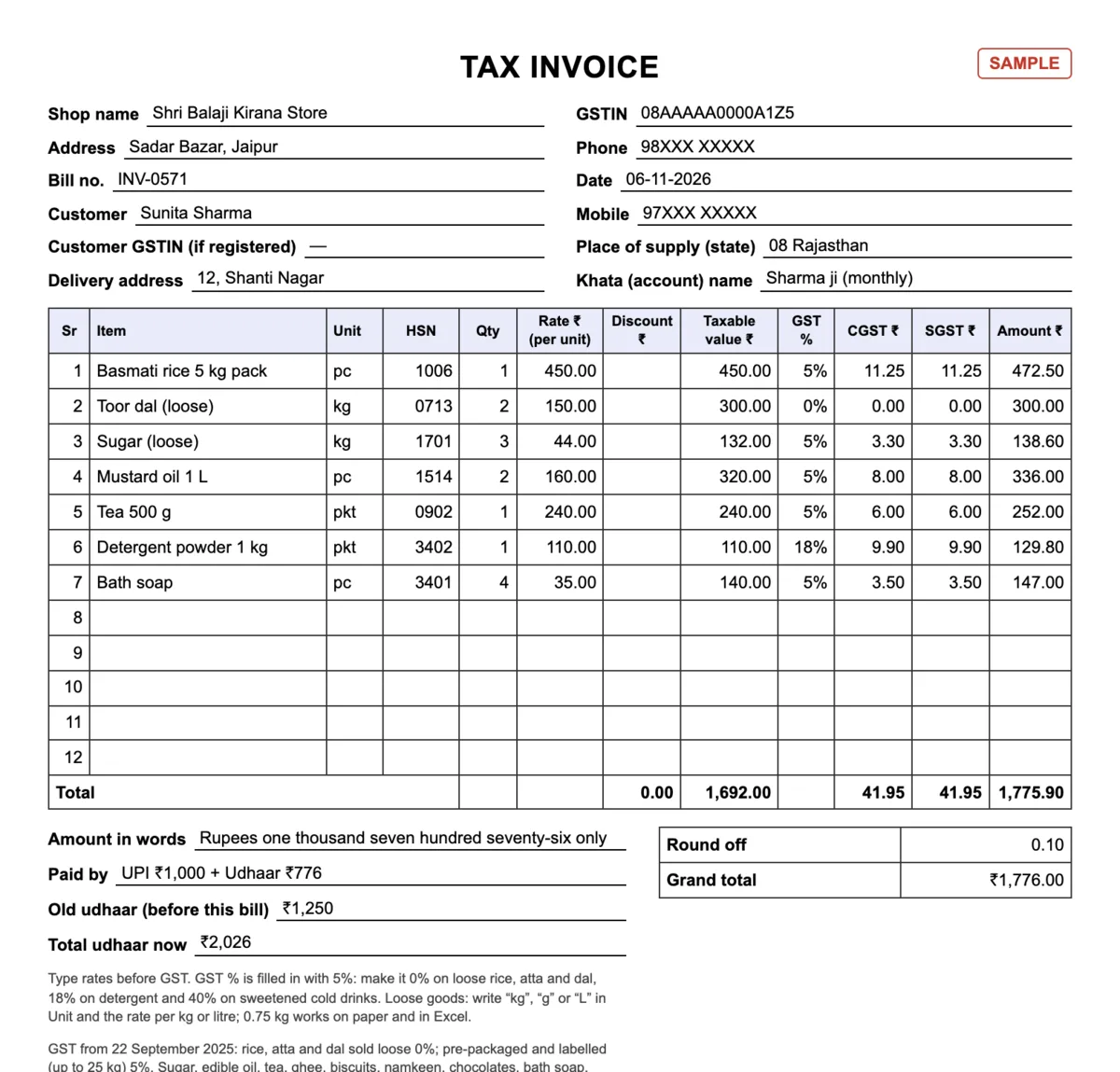
Still on a bill book? Our kirana formats fit a grain shop: a unit column (kg, bag, pc), HSN, GST % per line (0% or 5%), delivery address, account name and old and new udhaar lines. On paper and in Excel 12.5 kg works. English, Hindi and Gujarati, no sign-up.
| Format | English | हिंदी | ગુજરાતી |
|---|---|---|---|
| GST tax invoice: A4, unit (kg / g / L / pc / pkt), HSN, GST % per line (0%, 5%, 18%), delivery address, khata name, old and new udhaar (18 lines) | PDF · 129 KB | PDF · 205 KB | PDF · 223 KB |
| Bill / cash memo without GST: A5 bill book size, unit column, old udhaar line (12 lines) | PDF · 114 KB | PDF · 169 KB | PDF · 187 KB |
| Excel with formulas: GST bill (0.75 kg works), bill without GST, kirana HSN and GST list (2025 rates) and a filled example | Excel · 12 KB | Excel · 13 KB | Excel · 13 KB |
| Word: both bills, type your shop name once and print | Word · 4 KB | Word · 5 KB | Word · 5 KB |
Write a bag as one line (“Sona Masoori 26 kg bag”, unit “bag”, qty 4) and loose grain in kg. More on the columns: kirana bill format.
| Plan | Bills a month | Rough daily limit | Staff |
|---|---|---|---|
| Basic (₹199/month) | 1,000 bills / month | About 33 bills a day | 1 staff login |
| Starter (₹499/month) | 1,500 bills / month | About 50 bills a day | 2 staff logins |
| Growth (₹999/month) | 5,000 bills / month | About 166 bills a day | 5 staff logins |
| Pro (₹1,999/month) | Unlimited bills | No limit | 20 staff logins |
A small grain counter with up to 2 bills a day fits the Free plan (60 bills a month, ₹0, owner only). A neighbourhood grain shop with about 33 bills a day fits Basic (₹199 a month); with a helper billing too and up to about 50 bills a day, Starter; a busy shop with staff and up to about 166 bills a day, Growth. The trial counts your bills, so you can pick after two weeks. See pricing.
Check this list against your shop before you sign up. Tap & Bill bills what you sell to customers; it is not mandi or rice-mill software.
| You need | How it works in Tap & Bill | Status |
|---|---|---|
| Loose rice, dal, wheat by the kg | Switch on items sold by weight, set the item to Sold by: kg with the price per kg; tap 250 g to 5 kg, type 12.5, or type the ₹ amount (“₹100 ka”). | Today, every plan (Free too) |
| Full bags (25 kg, 26 kg, 50 kg) | One item per bag size, priced per bag (“Sona Masoori 26 kg bag”), billed in pieces: 4 bags = qty 4, up to 999 a line. | Today, every plan |
| A quintal at a time | A quintal is 100 kg: type 100 on a kg item (up to 999.999 kg a line, about 10 quintals), or bill full bags. There is no quintal unit. | Workaround |
| 0% on loose grain, 5% on packed | Give each item its own GST rate and HSN; the tax invoice shows the 0% and 5% lines apart. | Today, every plan |
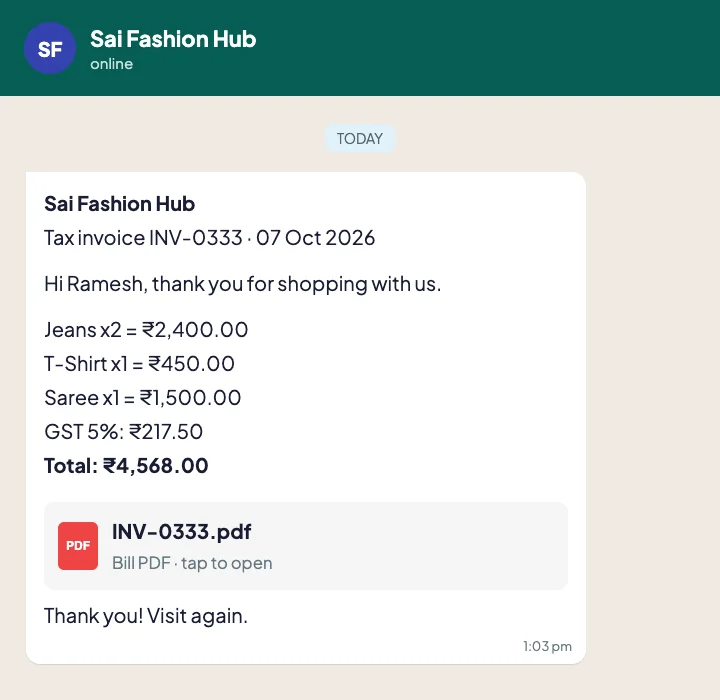
| Hotel, mess and caterer accounts | Bills on udhaar with a credit limit per customer (staff need your PIN to go over it); part payments; “Remind all” opens each reminder in your WhatsApp with your UPI ID, one tap per customer. | Today, every plan |
| Large bills | Bills above ₹1 lakh ask “sure?” first; one bill can be up to ₹25 lakh with GST (₹5 lakh without). Cash of ₹2 lakh or more on one bill is refused (Income Tax s.269ST): take UPI or bank for the rest. | Today |
| Weighing scale connected to the bill | Not available: weigh on your scale, then tap or type the weight. | Not available |
| Stock in kg or bags | Not available: kg items are billed and reported, not counted in stock (stock counts packed pieces, Growth plan and up). No bag-to-kg conversion. | Not available |
| Aadhat / commission, hamali, mandi fee, farmer purchase slips (J-form, 6R) | Not available: Tap & Bill bills your sales to customers. A commission agent in the APMC mandi needs mandi software. | Not available |
| Estimates and delivery challans in kg | Quotations and challans take whole pieces: fine for bags, not for loose kg lines. | Bags only |
| Sales to other states (IGST), e-way bills | Not available: bills are CGST + SGST, for buyers in your state. | Not available |
An aadhatiya in the APMC yard, a rice mill that buys paddy from farmers or a wholesaler shipping to other states needs mandi or ERP software. A rice, grain or anaj shop that sells loose and by the bag to households, hotels and smaller shops can start now.
Free plan: 60 bills a month for ₹0, owner only. Paid plans: Basic ₹199, Starter ₹499, Growth ₹999, Pro ₹1,999 a month, no GST added; Basic is also ₹1,499 a year. Every new shop first gets a 14-day free trial. See pricing and the Free plan.
For a counter that sells to households, hotels and smaller shops: one that bills loose grain by the kg and bags by the piece on one bill, puts 0% or 5% GST on each line, and keeps monthly accounts on udhaar. Tap & Bill does this on Android and any computer from ₹199 a month, or 60 bills a month free. For aadhat, mandi fee or farmer purchases, use mandi software.
Loose rice (weighed and sold in front of the customer) is exempt, 0%. Rice in a labelled retail pack up to 25 kg is 5%. A single bag of more than 25 kg is not a pre-packaged retail pack, so it is exempt. Brand does not matter. Sources: Notification 10/2025-CT(Rate) S. No. 67 and Notification 9/2025-IT(Rate) Schedule I S. No. 48.
No, if it is one single bag: the CBIC FAQs of 17 July 2022 say a single package of more than 25 kg is not “pre-packaged and labelled” for GST, so it is exempt. But several retail packs (say ten 5 kg packs) sold together in one big bag are taxed at 5%.
The same rule as rice: loose wheat, atta, other flours and dal are 0%; in a labelled retail pack of up to 25 kg they are 5%. Confirm processed items such as poha or besan with your CA.
1006 for rice, 1001 for wheat, 1101 for wheat flour (atta), 1102 for other cereal flours, 0713 for pulses (dal), 1008 for jowar, bajra and ragi. Take the full 8-digit code from your supplier’s bill and add it to the item; it prints on every GST bill.
There is no quintal unit. A quintal is 100 kg: type 100 on a kg item (one line takes up to 999.999 kg), or bill full bags as pieces (a 50 kg bag priced at half the quintal rate).
No. Weigh on your scale, then tap 250 g, 500 g, 1, 2 or 5 kg, type the weight, or type the ₹ amount. The bill shows “2.083 kg × ₹48/kg = ₹100”.
No. Tap & Bill has no aadhat or commission, hamali, mandi fee or farmer purchase slips (J-form, 6R). It bills your sales to customers. A commission agent in the mandi yard needs mandi software.
No. Loose items are billed and reported by the kg but not counted in stock. Stock and barcodes count packed pieces (Growth plan and up), so you could count bags as pieces; there is no bag-to-kg conversion.
Yes, on this page: our kirana formats (A4 GST bill, A5 bill without GST, Excel with formulas, Word) have a unit column, HSN and GST % per line, in English, Hindi and Gujarati. No sign-up.
Yes. The Free plan is ₹0 forever for 60 bills a month, owner only, with billing by the kg, GST bills, udhaar, UPI QR and WhatsApp bills. Every new shop first gets a 14-day free trial with all Growth features, no card.
We call you within one working day and show Tap & Bill on your own items and prices.
Prefer to talk now? Call +91 73838 34343.