Guide
Bill of supply format for composition dealers: free PDF, Excel and Word
What is a bill of supply, and what must its format show?
A bill of supply is the bill a GST-registered seller gives when it cannot charge GST on the sale: a composition dealer, or a regular dealer selling only exempt goods (CGST Act s.31(3)(c)). It shows “Bill of Supply”, the shop’s name, address and GSTIN, a serial number and date, the buyer (and their GSTIN if registered), HSN, items and value, and a signature, but no tax. A composition dealer also prints “Composition taxable person, not eligible to collect tax on supplies” on top. Download the format below (A4, A5, Excel, Word) or let Tap & Bill print it on every bill, Free plan included.
No card · no ads in the app · your bills, customers and udhaar stay yours: nothing is deleted if you stop paying
Download the bill of supply format (free, no sign-up)
| Format | English | हिंदी | ગુજરાતી |
|---|---|---|---|
| Bill of supply: A4, “BILL OF SUPPLY” and the composition line on top, GSTIN, HSN, unit, no tax columns (18 lines) | PDF · 139 KB | PDF · 240 KB | PDF · 251 KB |
| Bill of supply: A5 bill book size, the same fields (12 lines) | PDF · 113 KB | PDF · 204 KB | PDF · 202 KB |
| Excel with formulas: bill of supply (2.5 kg works), a filled example and a sheet for the 1% composition tax by month | Excel · 8 KB | Excel · 9 KB | Excel · 9 KB |
| Word: type your shop name and GSTIN once and print | Word · 3 KB | Word · 4 KB | Word · 4 KB |
The PDFs are blank forms: print and fill by hand, or give them to a printing press for a numbered bill book. The Excel file adds each line (2.5 kg × rate works), rounds the total, has a filled example and a third sheet that works out the 1% composition tax month by month. The Word file has the same form: type your shop name, address and GSTIN once, then print. Every language version keeps the English composition line under the Hindi or Gujarati one.
What a bill of supply must show (Rule 49)
| Field | What to write | Why |
|---|---|---|
| Heading | “Bill of Supply” | Tells the buyer no GST is charged |
| Composition line (composition dealers only) | “Composition taxable person, not eligible to collect tax on supplies”, at the top | Rule 5(1)(f); the shop signboard also says “composition taxable person” |
| Your shop | Name, address and 15-character GSTIN | You are registered, so the GSTIN is on every bill |
| Bill number | Serial, up to 16 characters, once in a financial year (BOS-0347) | Same rule as a tax invoice |
| Date | Date of the sale | |
| Buyer | Name, address and GSTIN if the buyer is registered | A walk-in customer needs no name on small bills |
| Items | Description, HSN, quantity, rate, discount, value | Value after discount; no GST rate or tax amount |
| Signature | Your signature or your authorised person’s | Not needed on an electronic bill |
What must not be on it: a GST rate, CGST, SGST or IGST amounts, “GST included” or “+ GST”. A composition dealer cannot collect tax from the buyer (s.10(4)), and the buyer gets no input tax credit from this bill. The tax you pay comes from your own pocket, as a small % of your sales (next section).
Example: a composition general store’s bill, ₹1,352
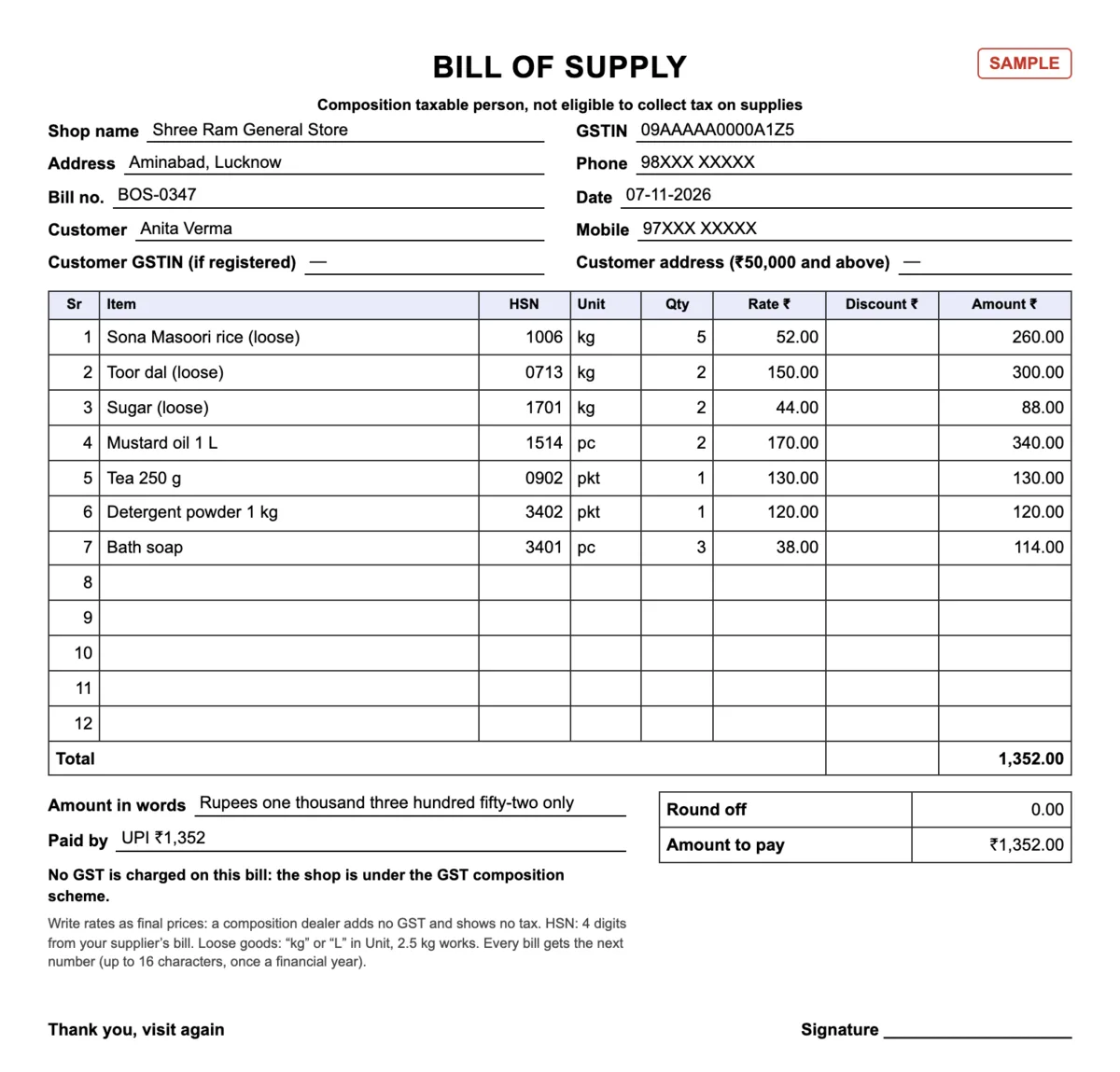
A general store in Lucknow under composition sells to a walk-in customer. Rates are final prices; the made-up numbers match the sample picture above:
| Item | HSN | Qty | Rate | Amount | For the composition tax |
|---|---|---|---|---|---|
| Sona Masoori rice (loose) | 1006 | 5 kg | ₹52/kg | ₹260 | Exempt (loose, not packed) |
| Toor dal (loose) | 0713 | 2 kg | ₹150/kg | ₹300 | Exempt (loose, not packed) |
| Sugar (loose) | 1701 | 2 kg | ₹44/kg | ₹88 | Taxable supply |
| Mustard oil 1 L | 1514 | 2 pc | ₹170 | ₹340 | Taxable supply |
| Tea 250 g | 0902 | 1 pkt | ₹130 | ₹130 | Taxable supply |
| Detergent powder 1 kg | 3402 | 1 pkt | ₹120 | ₹120 | Taxable supply |
| Bath soap | 3401 | 3 pc | ₹38 | ₹114 | Taxable supply |
| Customer pays | ₹1,352 |
The customer pays ₹1,352 and sees no tax line. The shop then works out its own composition tax: of the ₹1,352, ₹560 is loose rice and dal, which are exempt when not pre-packaged and labelled (Notification 10/2025-Central Tax (Rate), S. Nos. 67 and 39), so a trader leaves it out. Tax at 1% on the other ₹792 is ₹7.92 (CGST ₹3.96 + SGST ₹3.96), paid with the quarterly CMP-08. A regular GST shop would instead show 5% or 18% on each taxable line and collect it from the customer.
On a 58 mm thermal printer the same bill comes out like this (the app prints the composition line and HSN under each item; thermal receipts print in English letters):
         BILL OF SUPPLY
    SHREE RAM GENERAL STORE
       Aminabad, Lucknow
     GSTIN: 09AAAAA0000A1Z5
Composition taxable person, not
   eligible to collect tax on
            supplies
--------------------------------
Bill: BOS-0347    07/11/26 11:20
Cust: Walk-in
--------------------------------
Item          Qty  Rate   Amount
Sona Masoori                 260
  5 kg x 52/kg
  HSN 1006
Toor dal (loo                300
  2 kg x 150/kg
  HSN 0713
Sugar (loose)                 88
  2 kg x 44/kg
  HSN 1701
Mustard oil 1   2   170      340
  HSN 1514
Tea 250 g       1   130      130
  HSN 0902
Detergent pow   1   120      120
  HSN 3402
Bath soap       3    38      114
  HSN 3401
--------------------------------
Subtotal                    1352
--------------------------------
TOTAL                    Rs 1352
Paid by                      UPI
--------------------------------
Thank you, visit againBill of supply, tax invoice or plain bill?
| Your shop | Bill to give | Tax on the bill |
|---|---|---|
| Not registered under GST (below the limit) | Plain bill / cash memo | None, and no GSTIN; you may not collect any GST (s.32) |
| Registered under composition | Bill of supply with the composition line | None; you pay 1% (traders) yourself |
| Registered, regular, selling only exempt goods (loose grain, fresh vegetables) | Bill of supply (no composition line) | None |
| Registered, regular, taxable and exempt goods to an unregistered buyer | One “invoice-cum-bill of supply” (Rule 46A), or two bills | GST only on the taxable lines |
| Registered, regular, taxable goods | Tax invoice | GST rate, CGST + SGST on each line |
Not sure which you are? Your GST certificate says “Composition” or “Regular”. More on plain bills: bill without a GST number. In Hindi: टैक्स इनवॉइस और बिल ऑफ़ सप्लाई में अंतर.
Composition scheme basics for a shop
- Who can join: businesses with turnover up to ₹1.5 crore in the last financial year (₹75 lakh in some special-category states). Not for sales to other states.
- Tax: traders 1% of the turnover of taxable supplies in the state (0.5% CGST + 0.5% SGST; exempt goods left out), manufacturers 1%, restaurants 5%, service providers 6%.
- No input tax credit: the GST on your purchases is a cost; your buyers get no credit from your bills. Shops that sell mostly to GST-registered businesses often stay regular for this reason.
- Returns: CMP-08 every quarter (tax payment) and GSTR-4 once a year. Your CA will tell you this year’s dates.
- Signboard and bills: “composition taxable person” on the board; the composition line on top of every bill of supply.
Bill of supply in Tap & Bill
Save your GSTIN, then switch on Settings → GST → Composition dealer (Bill of Supply). From the next bill, every bill prints as a Bill of Supply: “BILL OF SUPPLY” on top (in Hindi, Gujarati or Marathi too, with the English words), the composition line under it, your GSTIN, HSN under each item, the buyer’s GSTIN if you add one, and a signature space; no GST is charged or shown. Old bills stay as they were.
- Billing as usual: tap items or type an amount on the Quick bill keypad, loose items by the kg (2.5 kg, “₹50 ka”), walk-in bills, UPI QR with the exact amount, udhaar, print on a 58 / 80 mm thermal printer or A4, and the PDF on WhatsApp. All of this is on the Free plan too (60 bills a month).
- The GST year report lists your composition sales (Bills of Supply less returns) by month and quarter, ready for CMP-08 and GSTR-4 (Basic plan and up, and the 14-day trial).
- Give each item its HSN once (from your supplier’s bill) and it prints on every Bill of Supply.
- The app checks your GSTIN (state code and check digit) before it turns composition on, and it will not let a composition shop charge GST by mistake.
What it does not do: file CMP-08 or GSTR-4 for you (give the report to your CA), make IGST bills for other states (composition dealers can’t sell there anyway), or join the day’s small walk-in sales under ₹200 into one consolidated bill by itself. Quotations and delivery challans take whole pieces, not kg.