Guide
Kirana store bill format: free Excel, Word and PDF, with loose items by the kg
What should a kirana store bill have?
A kirana bill lists each item with its unit (kg, g, litre or piece), the quantity, the rate per unit and the amount, then the total and how it was paid. Loose rice, dal and sugar are written by weight (“0.75 kg × ₹48/kg”). A GST-registered store also prints its GSTIN, the HSN and GST % of each line and CGST + SGST, because kirana rates differ: loose grain 0%, most packed food and soap 5%, detergent 18%, sweetened cold drinks 40%. Download a ready format below in Excel (with formulas), Word or PDF, in English, Hindi or Gujarati.
No card · no ads in the app · your bills, customers and udhaar stay yours: nothing is deleted if you stop paying
Download the kirana bill formats (free, no sign-up)
| Format | English | हिंदी | ગુજરાતી |
|---|---|---|---|
| GST tax invoice: A4, unit (kg / g / L / pc / pkt), HSN, GST % per line (0%, 5%, 18%), delivery address, khata name, old and new udhaar (18 lines) | PDF · 129 KB | PDF · 205 KB | PDF · 223 KB |
| Bill / cash memo without GST: A5 bill book size, unit column, old udhaar line (12 lines) | PDF · 114 KB | PDF · 169 KB | PDF · 187 KB |
| Excel with formulas: GST bill (0.75 kg works), bill without GST, kirana HSN and GST list (2025 rates) and a filled example | Excel · 12 KB | Excel · 13 KB | Excel · 13 KB |
| Word: both bills, type your shop name once and print | Word · 4 KB | Word · 5 KB | Word · 5 KB |
The PDFs are blank forms to print and fill by hand, or to take to a printing press for a numbered bill book. The Excel file works out the taxable value, CGST, SGST, amount, round off and grand total; GST % starts at 5% on every line, so you change it only where an item has another rate (0% loose grain, 18% detergent). Quantities can have decimals, so 0.75 kg works. Its other sheets are a bill without GST, the kirana HSN and GST list below, and the filled example above. The Word file has both bills to type your shop name before printing.
What goes on a kirana bill
| Field | On a GST tax invoice? | Why kirana stores write it |
|---|---|---|
| Shop name, address, GSTIN | Yes (Rule 46) | Only a registered shop has a GSTIN; a shop without GST leaves it out and adds no tax. |
| Bill number and date | Yes: one series, no number used twice in a financial year | Your CA matches the bills with the GST return; the customer can find the bill again. |
| FSSAI licence or registration number | Not a GST field | An FSSAI order of 8 June 2021 asks food businesses to print the 14-digit number on bills, from 1 October 2021. |
| Item and unit (kg, g, L, pc, pkt) | Description and quantity: yes; the unit code (UQC) is in the HSN summary | Loose rice and dal are sold by weight, packets by the piece. |
| Quantity and rate per unit | Yes | 0.75 kg × ₹48 per kg reads clearly; rounding a weight to whole kg cheats one side. |
| HSN code and GST % | Yes, per line | Kirana rates differ line by line: 0%, 5%, 18% and 40%. |
| CGST and SGST | Yes | Half and half for a sale in your own state. |
| Old udhaar and total udhaar now | No | Regular customers on a monthly account see what they owe after this bill. |
| Delivery address | No | For home delivery and phone orders. |
| Signature | Yes | Sign the copy you give. |
Rule 46 of the CGST Rules lists what a tax invoice must show. A registered store need not make a separate tax invoice for a sale under ₹200 to an unregistered customer who does not ask for one, but it must make one consolidated tax invoice for all such sales at the end of the day (Section 31(3)(b) of the CGST Act and Rule 46); more in Hindi: pakka bill. A store that is not registered uses the A5 bill without GST: no GSTIN and no tax lines (bill without a GST number).
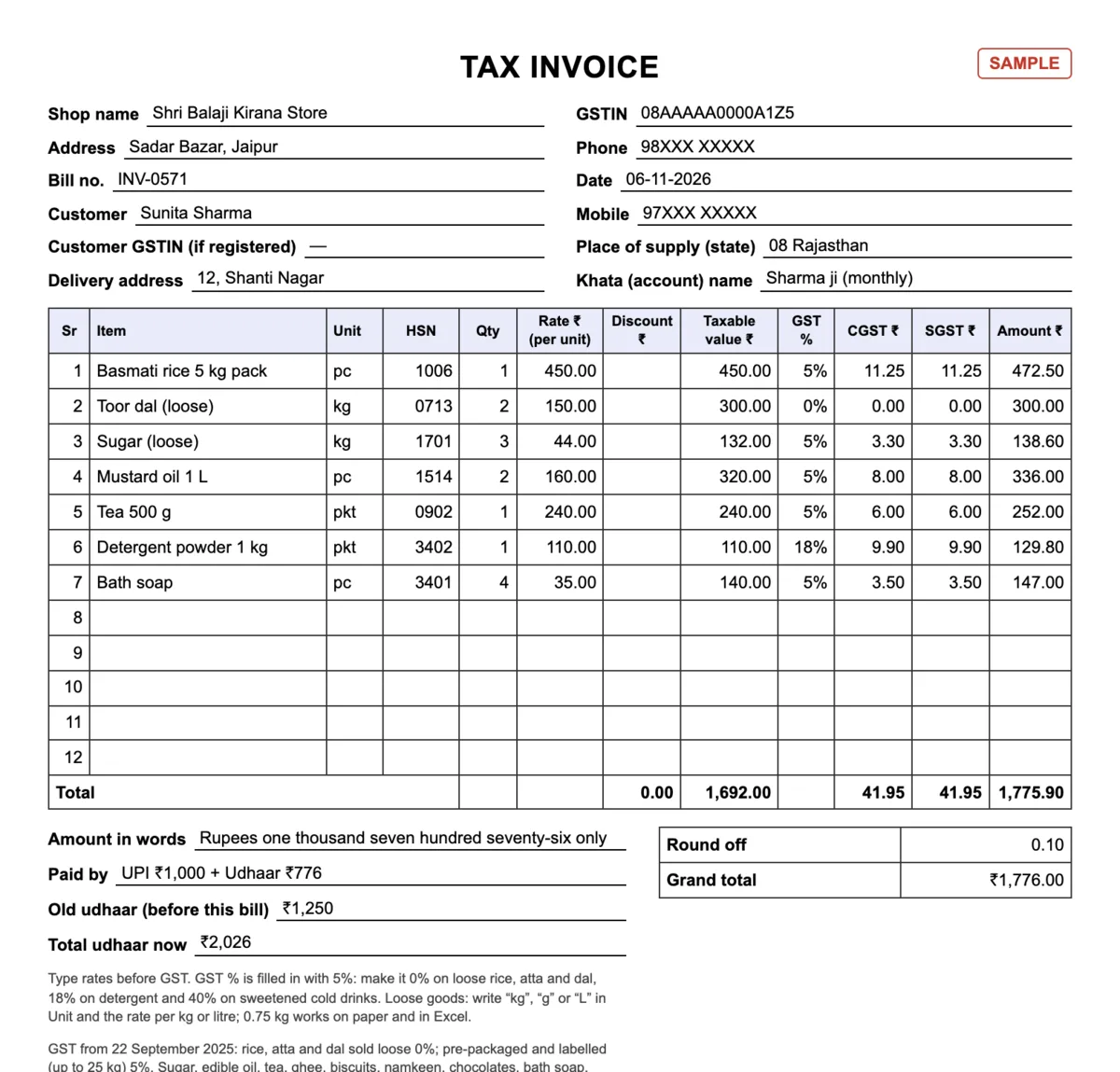
Filling the format: a sample monthly-account bill
Download the format
Pick the A4 GST tax invoice (PDF), the A5 bill without GST (PDF), the Excel with formulas or the Word file, in English, Hindi or Gujarati.
Fill your shop details once
Shop name, address, phone, GSTIN if registered, and your FSSAI number (in Excel or Word type them once; for a printed book, ask the printer to put them in).
One line per item, with the unit
Loose goods: write kg, g or L in Unit, the quantity (0.75) and the rate per kg or litre. Packets: pc or pkt and the MRP rate. A GST bill also needs the HSN and the GST % of each line.
Totals, udhaar and payment
Round off, the total in figures and words, how it was paid (cash, UPI or udhaar), and for a monthly account the old udhaar and the new total. Sign and give the customer copy.
In the sample above, Sharma ji’s monthly order has a 5 kg basmati pack, 2 kg of loose toor dal, 3 kg of loose sugar, two litres of mustard oil, tea, a detergent pack and four soaps: ₹1,692 taxable, CGST ₹41.95 + SGST ₹41.95, total ₹1,776. She pays ₹1,000 by UPI and ₹776 goes on her account, so her udhaar goes from ₹1,250 to ₹2,026.
GST rates on kirana items (from 22 September 2025)
After the GST changes of 22 September 2025, most packed food and toiletries in a kirana are 5%: biscuits and chocolates came down from 18%, ghee, butter and namkeen from 12%, and bath soap, toothpaste, hair oil and shampoo from 18%. Loose rice, atta and dal stay at 0%. Detergent stays 18%. Aerated and sweetened cold drinks (cola, soda with sugar or flavour, fizzy fruit drinks) went up from 28% to 40%, while fruit-pulp or fruit-juice drinks that are not fizzy, such as Frooti or Maaza, came down to 5%.
| Item | HSN heading | GST from 22 Sep 2025 | Just before |
|---|---|---|---|
| Rice, atta, dal and other grains, sold loose | 1006 / 1101 / 0713 | 0% | 0% (no change) |
| Rice, atta, dal, pre-packaged and labelled (up to 25 kg) | 1006 / 1101 / 0713 | 5% | 5% (no change) |
| Sugar | 1701 | 5% | 5% (no change) |
| Edible oil: mustard, groundnut, soybean, sunflower | 1507–1515 | 5% | 5% (no change) |
| Tea | 0902 | 5% | 5% (no change) |
| Ghee and butter | 0405 | 5% | 12% |
| Biscuits | 1905 | 5% | 18% |
| Namkeen and bhujia | 2106 90 | 5% | 12% |
| Chocolates | 1806 | 5% | 18% |
| Bath soap (bars) | 3401 | 5% | 18% |
| Toothpaste, hair oil, shampoo | 3306 / 3305 | 5% | 18% |
| Detergent powder and liquid | 3402 | 18% | 18% (no change) |
| Aerated / sweetened cold drinks: cola, soda with sugar or flavour, fizzy fruit drinks | 2202 10 / 2202 | 40% | 28% |
| Fruit-pulp or fruit-juice drinks, not fizzy (e.g. Frooti, Maaza) | 2202 99 20 | 5% | 12% |
Loose or packed? Rice, atta, dal and other grains pay 5% only when they are “pre-packaged and labelled” for retail sale, in packs up to 25 kg. Sold loose, or weighed out by you from a bag, they are not taxed. A single bag of more than 25 kg, such as a 50 kg rice bag, is not “pre-packaged and labelled” for GST either, so it is not taxed; ten 10 kg retail packs sold together in one outer bag are. Sugar, oil and tea are 5% packed or loose.
Cold drinks in the app: give the Cold drinks item or category its own 40% rate in Tap & Bill (0%, 5%, 18% and 40% are all on the rate picker, phone and computer). A ₹40 bottle at MRP then holds ₹11.43 GST, and the bill prints GST 40% = CGST 20% + SGST 20%. Keep fruit-pulp drinks like Frooti or Maaza at 5%.
Need the GST on one price? Add it, or take it out of an MRP, at 0%, 5%, 18% or 40% with the free GST calculator (it also lists rates for bakery, mobile, cosmetics and other shop goods).
Loose items by weight: how to write them
- Write the weight with up to three decimals and the rate per kg: 0.725 kg × ₹47.50/kg = ₹34.44. Round the amount to the paisa, not the weight.
- “₹50 ka chawal”: divide the rupees by the rate. ₹50 ÷ ₹47.50 = 1.053 kg, and the line stays ₹50.
- Grams for small things (100 g jeera at ₹600 per kg = ₹60), litres for loose oil.
- Packets (Atta 5 kg pack, Oil 1 L) are pieces at their MRP; don’t mix a packet and a loose line of the same item.
Rice, atta and grain shops
A grain or rice shop sells the same goods two ways: by the kg to households and by the bag to hotels, caterers and smaller shops. On the bill, a bag is one line in pieces (“Sona Masoori 25 kg bag × 4”), loose grain is a line in kg, and a quintal is simply 100 kg. Mandi work (commission, hamali, mandi fee, farmer purchase slips) needs mandi software; these formats are for selling to customers. A full hotel order with 26 kg bags at 0% and packed rice at 5%, and the GST rules for grain with sources: billing for rice and grain shops.
Kirana bill book (to get printed)
For a printed book, take the A5 or A4 PDF to a printing press and ask for numbered sets (customer copy on top, shop copy below, carbon or carbonless paper), your shop name, address, GSTIN and FSSAI number printed at the top, and 50 or 100 sets per book. A GST-registered store should print the A4 tax invoice; a store without GST, the A5 bill.
Making the same bill in Tap & Bill
Tap & Bill makes this bill on an Android phone or any computer, prints it on a 58 or 80 mm thermal printer or A4, and sends the PDF on WhatsApp. An everyday walk-in bill at a store without GST:
| Line | How it was added | Amount |
|---|---|---|
| Rice (loose) 1.053 kg × ₹47.50/kg | Rice is sold by kg: the customer asked for ₹50, typed 50 on “₹ amount” | ₹50 |
| Toor dal 0.5 kg × ₹160/kg | Tapped 500 g on the pad | ₹80 |
| Sugar 1.5 kg × ₹46/kg | Typed 1.5 | ₹69 |
| Atta 5 kg pack × 1 | Tile | ₹245 |
| Mustard oil 1 L × 1 | Tile | ₹165 |
| Bath soap × 3 | Tile, tapped three times | ₹114 |
| Item 7 | Quick bill: typed ₹20, no name | ₹20 |
| Total | ₹743 |
And the GST store’s monthly order in the app, with MRP prices (GST included), the shop rule “same rate on everything” 5%, loose dal at its own 0% and detergent at its own 18%:
| Item | Qty | Price (GST incl.) | GST | Value without GST | GST inside |
|---|---|---|---|---|---|
| Basmati rice 5 kg pack | 1 | ₹475 | 5% | ₹452.38 | ₹22.62 |
| Toor dal (loose) | 2 kg | ₹150/kg | 0% | ₹300 | ₹0 |
| Sugar (loose) | 3 kg | ₹46/kg | 5% | ₹131.43 | ₹6.57 |
| Mustard oil 1 L | 2 | ₹170 | 5% | ₹323.81 | ₹16.19 |
| Tea 500 g | 1 | ₹250 | 5% | ₹238.10 | ₹11.90 |
| Detergent powder 1 kg | 1 | ₹120 | 18% | ₹101.69 | ₹18.31 |
| Bath soap | 4 | ₹38 | 5% | ₹144.76 | ₹7.24 |
| Customer pays | ₹1,775 | ₹1,692.17 | ₹82.83 |
GST inside: ₹64.52 at 5% and ₹18.31 at 18%; she pays ₹1,000 by UPI and ₹775 goes on her udhaar with a split payment.
- Items sold by weight (kg, g, L) on every plan, the Free plan too: tap 250 g, 500 g, 1 kg or type the ₹ amount. A kirana shop starts with rice, atta, sugar, dal, poha and besan per kg and loose oil per litre; a regular’s lower rate goes in the same pad (“Change rate”, this bill only). On the thermal receipt the weight and rate print under the item (“0.25 kg x 60/kg”). How it works.
- GST: one shop rate plus an item’s own rate (0% for loose grain, 18% for detergent, 40% for aerated cold drinks); HSN on every line of the tax invoice; FSSAI number in the bill footer line.
- Udhaar for monthly accounts: the Udhaar due list, part payments and a WhatsApp reminder with your UPI ID; old balances from your diary can be imported once from Excel (paid plans).
- Packet barcodes with Stock & barcodes (Growth and Pro): scan with a scanner or the phone camera; stock counts pieces only.
- Not available: stock in kg or litres, batch and expiry dates, a weighing-scale connection, and IGST bills for goods sent to another state (bills are for sales within your state).
From ₹199 a month, or 60 bills a month on the ₹0 Free plan; 14 days free. More: billing app for kirana and small shops.